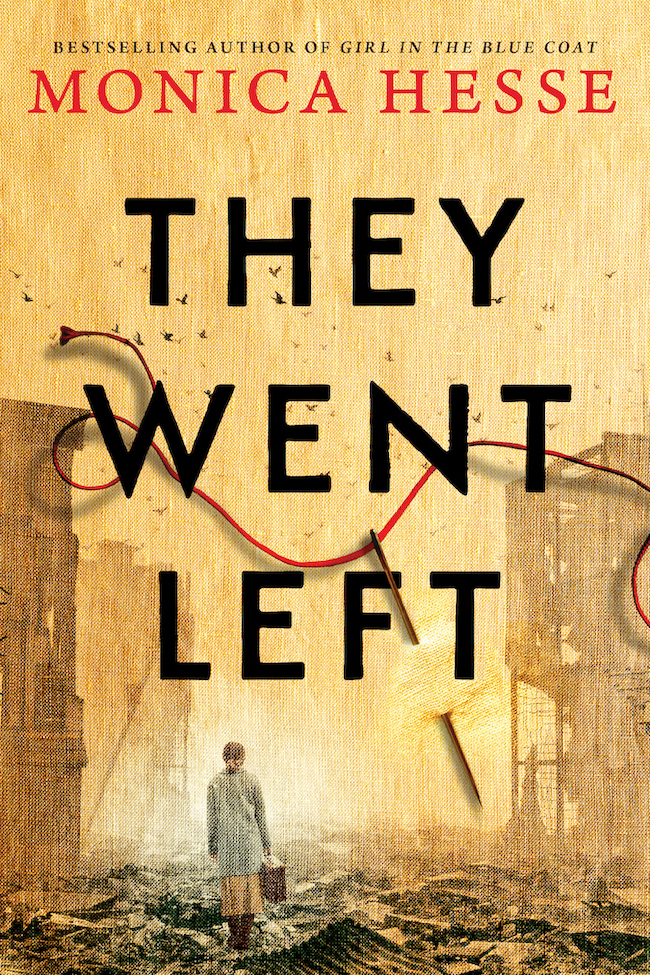
Hello, friends! I’m back with another The Fantastic Flying Book Club blog tour today and this time it’s for They Went Left by Monica Hesse! Every time I get picked to be part of any FFBC blog tour I die a little bit inside out of pure happiness because it’s always such a privilege 🥰 Huge thanks to FFBC for organising these amazing tours and to the authors as well for making the eARCs available to us.
Be sure to click on the banner above to see the other bloggers on tour! 😊
They Went Left Publisher: Little, Brown Books for Young Readers Release date: 07 April 2020 Genre: Young Adult, Historical Fiction, WWII
Panda Rating:
Germany, 1945. The soldiers who liberated the Gross-Rosen concentration camp said the war was over, but nothing feels over to eighteen-year-old Zofia Lederman. Her body has barely begun to heal; her mind feels broken. And her life is completely shattered: Three years ago, she and her younger brother, Abek, were the only members of their family to be sent to the right, away from the gas chambers of Auschwitz-Birkenau. Everyone else–her parents, her grandmother, radiant Aunt Maja–they went left.
Zofia’s last words to her brother were a promise: Abek to Zofia, A to Z. When I find you again, we will fill our alphabet. Now her journey to fulfill that vow takes her through Poland and Germany, and into a displaced persons camp where everyone she meets is trying to piece together a future from a painful past: Miriam, desperately searching for the twin she was separated from after they survived medical experimentation. Breine, a former heiress, who now longs only for a simple wedding with her new fiancé. And Josef, who guards his past behind a wall of secrets, and is beautiful and strange and magnetic all at once. But the deeper Zofia digs, the more impossible her search seems. How can she find one boy in a sea of the missing? In the rubble of a broken continent, Zofia must delve into a mystery whose answers could break her–or help her rebuild her world.
Yayaya, HAPPY FRIYAY, book lovers and friends 😍We’re back with another First Lines Friday! This is a weekly featurefor book lovers hosted by Wandering Words. What if instead of judging a book by its cover, its author or its prestige, we judged it by its opening lines?Here areTHE RULES:
Pick a book off your shelf (it could be your current read or on your TBR) and open to the first page
Copy the first few lines, but don’t give anything else about the book away just yet – you need to hook the reader first
Finally… reveal the book!
First lines:
It turns out the Leteo procedure isn’t bullshit.
The first time I saw a poster on the subway promoting the institute that could make you forget things, I thought it was a marketing campaign for some new science fiction movie. And when I saw the headline “Here Today, Gone Tomorrow!” on the cover of a newspaper, I mistook it as something boring, like the cure for some new flu—I didn’t think they were talking about memories.
Do you recognize the book these first lines come from?
In the months after his father’s suicide, it’s been tough for sixteen-year-old Aaron Soto to find happiness but with the support of his girlfriend Genevieve, he’s slowly remembering what that might feel like. When Genevieve leaves for a couple of weeks, Aaron starts hanging out with a new guy, Thomas. Aaron’s friends notices, and they’re not exactly thrilled. But Aaron can’t deny the happiness Thomas brings or how Thomas makes him feel safe from himself.
Since Aaron can’t stay away from Thomas or turn off his newfound feelings for him, he considers turning to the Leteo Institute’s revolutionary memory-alteration procedure to straighten himself out, even if it means forgetting who he truly is…
Have you read More Happy Than Not or is it on your TBR? Leave me a comment and let’s chat 🙂
Yayaya, HAPPY FRIYAY, book lovers and friends 😍We’re back with another First Lines Friday! This is a weekly featurefor book lovers hosted by Wandering Words. What if instead of judging a book by its cover, its author or its prestige, we judged it by its opening lines?Here areTHE RULES:
Pick a book off your shelf (it could be your current read or on your TBR) and open to the first page
Copy the first few lines, but don’t give anything else about the book away just yet – you need to hook the reader first
Finally… reveal the book!
First lines:
“The Nazi officers are dressed in black. They look at death with the indifference of a gravedigger. In Auschwitz, human life has so little value that no one is shot anymore; a bullet is more valuable than a human being.”
Do you recognize the book these first lines come from?
Based on the experience of real-life Auschwitz prisoner Dita Kraus, this is the incredible story of a girl who risked her life to keep the magic of books alive during the Holocaust. Fourteen-year-old Dita is one of the many imprisoned by the Nazis at Auschwitz. Taken, along with her mother and father, from the Terezín ghetto in Prague, Dita is adjusting to the constant terror that is life in the camp. When Jewish leader Freddy Hirsch asks Dita to take charge of the eight precious volumes the prisoners have managed to sneak past the guards, she agrees. And so Dita becomes the librarian of Auschwitz. Out of one of the darkest chapters of human history comes this extraordinary story of courage and hope.
Have you read The Librarian of Auschwitz or is it on your TBR? Leave me a comment and let’s chat 🙂
One night fifteen-year-old Lina, her mother and young brother are hauled from their home by Soviet guards, thrown into cattle cars and sent away. They are being deported to Siberia. An unimaginable and harrowing journey has begun. Lina doesn’t know if she’ll ever see her father or her friends again. But she refuses to give up hope. Lina hopes for her family. For her country. For her future. For love – first love, with the boy she barely knows but knows she does not want to lose… Will hope keep Lina alive?
Late one evening in 1941, 15-year-old Lina is dragged out of her home by Soviet soldiers, alongside her mother and brother. She’s confused, scared, worried for her father and most of all wondering, why them? This story chronicles their journey to and their experience in Siberia where Lina and hundreds of thousands of Lithuanians, Estonians, and Latvians identified as criminals against Soviet rule were deported to slave in labour camps or outright exterminated. With her world torn apart and having to deal with trauma, loss, grief and despair, Lina keeps a tight hold to the hope of survival through her memories and love of art.
“Have you ever wondered what a human life is worth? That morning, my brother’s was worth a pocket watch.”
This was a harrowing and heartbreaking novel full of enduring hope in the face of absolute brutality and injustice. It was a testament to hope and love and kindness. I have always been gripped by historical fictions ever since I read books like Anne Frank’s Diary, the Devil’s Arithmetic, Night, and others in school. I admit though, that I didn’t have any prior knowledge about the same horrors happening in other countries and to other peoples during that same period. This was a very educational read, as much as it was a poignant account of those who suffered under Soviet rule.
“Was it harder to die or harder to be the one who survived? I was sixteen, an orphan in Siberia, but I knew. It was the one thing I never questioned. I wanted to live.”
Sepetys writes in a simple, yet powerful and compelling way that made it difficult to put this book down. I dreaded having to leave for work in the morning because I knew I had to put it to the back of mind and I couldn’t wait to race home and pick it up again at days end. I thought that all the characters in the book were well written and many of them had believably mature personas that I oftentimes forgot that Lina was only a teenager and her brother Jonas, only a boy.
I greatly admired Lina’s strength of character throughout her story and her ability to keep hanging on to hope even in the most dire of circumstances and through the most debilitating of losses. Her strength and even youthful optimism in the face of adversity lent a lightness and much needed hopefulness to the situation that reminded me in ways of Anne Frank and her perception of her situation. Just as Anne did, I liked that rebellious Lina recorded events through her art and writing, despite the dangers of being discovered. Maybe it was selfish at times but it was also her way of ensuring that nothing was ever forgotten. What I also found very inspiring was that despite the amount of suffering that was inflicted upon Lina, her family and those around her, there was so much forgiveness and even kindness given to the enemy. All the characters felt so very much like family at the end and even the most frustrating/maddening characters managed to redeem themselves too.
Although I felt the ending came quite abruptly, I can see why it was done that way, and I thought it wrapped the story up on a positive note, giving readers hope that there will be a somewhat happy ending to this story after all.
“…evil will rule until good men or women choose to act. It is my greatest hope that the pages…stir your deepest well of human compassion. I hope they prompt you to do something, to tell someone. Only then can we ensure that this kind of evil is never allowed to repeat itself.”
This book made me think a lot about how despite having learned something from our history, it seems that we haven’t learned enough from it. There is still so much fear in people—fear of differences and of things that they don’t understand. It’s disheartening to know that there are still so many greedy, selfish and egotistical people in positions of power who use their words and actions to rouse hatred towards and stoke fear of others. But still, I believe in the power of human compassion and I stand with those who find the strength to step up against these types of people and their abhorrent actions. In her authors note at the end, Sepetys gave more background information to the Soviet massacre of over three million citizens of the Baltic states. I think the greatest lesson to be taken from this novel was beautifully summarized by her:
“Some wars are about bombings. For the people of the Baltics, this was was about believing. In 1991, after fifty years of brutal occupation, the three Baltic countries regained their independence, peacefully and with dignity. They chose hope over hate and showed the world that even through the darkest night, there is light… These three tiny nations have taught us that love is the most powerful army… —love reveals to us the truly miraculous nature of the human spirit.”
This was a fast and beautifully written read. I definitely look forward to reading more books written by Ruta Sepetys!
Have you read The Astonishing Color of After? What’d you think of it? Let me know in the comments and let’s chat!








 dinipandareads