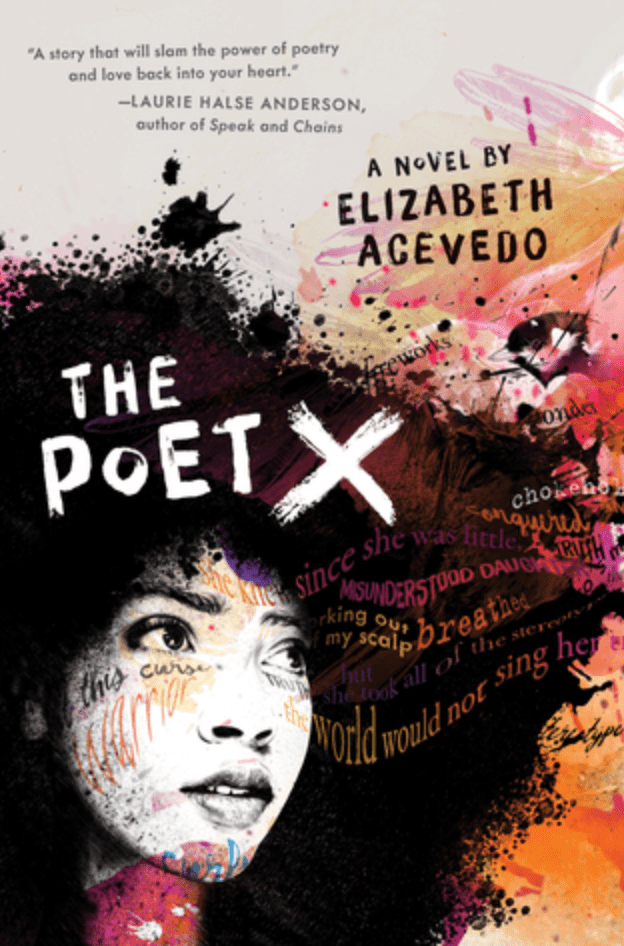
The Poet X by Elizabeth Acevedo – #BookReview

Goodreads: The Poet X
Genre: Young Adult Contemporary, Poetry
Rating:

Xiomara Batista feels unheard and unable to hide in her Harlem neighborhood. Ever since her body grew into curves, she has learned to let her fists and her fierceness do the talking.

But Xiomara has plenty she wants to say, and she pours all her frustration and passion onto the pages of a leather notebook, reciting the words to herself like prayers—especially after she catches feelings for a boy in her bio class named Aman, who her family can never know about. With Mami’s determination to force her daughter to obey the laws of the church, Xiomara understands that her thoughts are best kept to herself.

So when she is invited to join her school’s slam poetry club, she doesn’t know how she could ever attend without her mami finding out, much less speak her words out loud. But still, she can’t stop thinking about performing her poems.

Because in the face of a world that may not want to hear her, Xiomara refuses to be silent. 

An honest and beautiful book written in a unique format about a young woman finding herself and her place a world that tells her she’s too much or not enough through the art of spoken word poetry. Would 100% recommend listening to the audiobook while following along with the book!

This was my first time reading a novel in this format, poetry, and while it made it a really unique, enjoyable and fast read, I also felt a little disconnected to many of the characters, except Xiomara. Of course, this was her story. Her thoughts and emotions come through very strongly through Acevedo’s writing and what made me appreciate the style more was listening to it being read by the author on audiobook (which I followed along to with the physical book). The author herself is a spoken word poet and I loved that this was the something that Xiomara was so passionate about. Following Xio’s journey of finding herself through poetry, navigating first love with Aman, maintaining the close bond with her twin Xavier and her best friend Caridad, and dealing with the tumultuous relationship with her extremely pious mother was a very intimate experience.

“And I think about all the things we could be if we were never told our bodies were not built for them.” 

There are a lot of issues tackled within this story and considering it’s told in verse, I thought that they were explored well. Xiomara is a very empowering, driven and smart character who was trying so hard to find her place and where she fit in a society where she has been over sexualized and objectified, and made to feel not good enough. She has for so long let her fists do her talking for her until the day she discovers slam poetry. The way she slowly comes to understand how she sees the world, where she fits in the world, and grows to find beauty in her skin through the power of spoken word poetry is so very beautiful.

“When has anyone ever told me
I had the right to stop it all
without my knuckles, or my anger,
with just some simple words.”

That said, I found the ending quite rushed. After the big incident at her house where the story reached a very heartbreaking and infuriating climax, I thought the issues between Xio and her mother were resolved very quickly and not in a very satisfying way. I was hoping for it to be hashed out a bit more, and although we experience some of the process, it felt like a “too clean” resolution; especially when the tension and misunderstanding was so high, only for everything to be good again in a short time. Especially when this conflict between the two women was such a big part of the story. I wished we’d gotten to really see how Xiomara and her mother came to terms with their vast differences because what happened between them was big and slightly frightening. While I love a happy ending (and maybe I’m just too jaded for saying this lol) this was such a picture perfect one that it felt a little unrealistic.

“I only know that learning to believe in the power of my own words has been the most freeing experience of my life. It has brought me the most light. And isn’t that what a poem is? A lantern glowing in the dark.” 

Another thing that disappointed me just a little was that we never got to see the poem that she recited at the final show. This is just my gripe but I was so excited to read what she spoke about and I was honestly really sad that we didn’t get to experience it.

“Late into the night I write and the pages of my notebook swell from all the words I’ve pressed onto them. 
It almost feels like the more I bruise the page the quicker something inside me heals.” 

Overall though, this was a beautifully told story and I think it’s one that many young women who don’t feel comfortable in their skin, or who are still looking for a way to fit in as they are, will be able to relate to and feel empowered by. Did I mention that this was extremely quotable? I’m very keen to read more from Acevedo!

Have you read The Poet X? Loved it? Hated it? Felt ‘meh’ about it?
Leave me a comment below and let’s chat!


The Surface Breaks by Louise O’Neill – #BookReview

Goodreads: The Surface Breaks
Genre: Young Adult, Fantasy, Retelling
Rating:

Deep beneath the sea, off the cold Irish coast, Gaia is a young mermaid who dreams of freedom from her controlling father. On her first swim to the surface, she is drawn towards a human boy. She longs to join his carefree world, but how much will she have to sacrifice? What will it take for the little mermaid to find her voice? Hans Christian Andersen’s original fairy tale is reimagined through a searing feminist lens, with the stunning, scalpel-sharp writing and world building that has won Louise her legions of devoted fans. A book with the darkest of undercurrents, full of rage and rallying cries: storytelling at its most spellbinding.

A dark feminist fairytale retelling of the beloved Little Mermaid. If you’re expecting something like the Disney movie, you’ve definitely picked up the wrong book! O’Neill’s writing hooked me (hah) from the start and had me rooting for the character I least expected!

Here is another Rusalka made. Another human woman set on fire by an insatiable man, needing to swallow the sea so she can douse the flames in her heart. She will lament her fate for the next three hundred years. She will sing sailors to their graves for her vengeance. And despite everything that I have been told about the Salkas, despite the fact that they killed my Uncle Manannán and drove my mother into the arms of the Sea King, I would not blame her.

Well, this book was certainly not what I expected. Growing up, I had always loved the Little Mermaid best out of all the Disney movies. The music was fun, Ariel was beautiful, her voice was magical and of course, Prince Eric was handsome (dat smile tho)! Even as an adult I still enjoy the movie – mostly for the music, but also for the nostalgia of those childhood days. I had never read the original Hans Christian Anderson story though, but thanks to a circulating Buzzfeed article on the original stories behind Disney classics, I knew it was dark. So when I started this book, I had that half in mind, but also the Disney version I love so much. Still, I don’t think I was ready for how dark this retelling would be!

Louise O’Neill paints a bleak story of a radically patriarchal kingdom of merfolk, where mermaids are meant as mere things that obey the every word of mermen and that whatever the merman says, goes. As Gaia escapes this oppressive world she has grown up in, she comes to find that in the human world, women are also ignored and thought of as weak creatures who are only appreciated by men for their looks and “open legs”. It was instilled by her father, the Sea King, that women are only good for their beauty and their ability to obey and be quiet, so it is no surprise that she believes the same of men on the surface. Sadly, it is this that gets the boulder rolling downhill, leading to the dire situation she finds herself in as the book progresses. It is a stark allegory of our society and I think extremely relevant, especially considering the rising discourse today. How far we have to go on that front…

She’s crazy, we used to say about maids in the kingdom who pursued mer-men relentlessly… I’m beginning to wonder that if, when we call a woman crazy, we should take a look at the man by her side, and guess at what he has done to drive her to insanity.

When I read that this was a feminist retelling of the classic I was wondering what that’d look like and the further I read, the more I appreciated how O’Neill weaved the feminist conversation into the story. The oft-repeated female trope of pitting women against each other is also present in the story, perpetrated by Gaia and other female characters against her; no surprise, considering how much men/masculinity is revered in ‘their’ world. Gaia wasn’t a very convincing feminist main character for a good portion of the book and only grew into it at the very end. She spent the majority of the story blinded to the reality that she seemed to recognize was wrong, only to push it aside because of her desperation to make a man-boy love her. It was a little frustrating but there’s no denying that O’Neill did a great job of capturing the restlessness and naïveté of a young girl on the cusp of womanhood. That said, I do wish that there was more of an ending. I felt like the climax and the conclusion were one and the same, so just as I thought we’d see more fight and fierce-woman action from Gaia, the story ended. It was rushed and a little unsatisfying. So much of the story was filled with pining for a boy, a failed love story in a sense, and the story only began to strengthen when the Sea Witch, Ceto, reappeared at the end. Who, by the way, ended up being my favorite character in this book!

“Your religion should help you make the decision if you find yourself in that situation, but the policy should exist for you to have the right to make it in the first place. 
When you say you can’t do something because your religion forbids it, that’s a good thing. When you say I can’t do something because YOUR religion forbids it, that’s a problem.”

Although she went about it in her characteristically evil way, and yes, it was wrong… Ceto was actually empowering and I feel she was the only “true feminist” of the whole book. If O’Neill made a book about Ceto, I’d definitely read it!

Overall, this book really took me by surprise. It was a fairly quick but enjoyable read (even though it had big text which I’m not a fan of, yes I’m one of those people that like small text!). The story certainly didn’t shy away from the brutality and anger, but also the passion, strength and love that make this society. Alas, the cute Disney love story was eclipsed by one of the desperate longing of a confused girl filled with wanderlust, who has spent her lifetime searching for answers and fighting all she has known to find her true self. The Little Mermaid will certainly never be the same again.

Also, MAJOR COVER APPRECIATION! Not only are the colors and the details in the artwork of the sleeve beautifully done but the naked cover of the hardback is just as beautiful too with a scale design. Every time my eye passes over where it sits on my bookshelf I just want to pick it up and stare at it because it’s so gorgeous!

Have you read The Surface Breaks? Loved it? Hated it? Felt ‘meh’ about it? Leave me a comment below and let’s chat!